Rio de Janeiro
Brazil
Mar 8, 2023 - Mar 9, 2023
Arrival 13:00 - Departure 17:00
Stop dreaming of Brazil and actually live it in the famous Copacabana beach. One of the most beautiful bays in the world is, not surprisingly, found in one of the most magnificent cities.
Take advantage of this stop in the port of Rio de Janeiro to find out why this metropolis is known as the “wonderful city." You can relax on the famous Copacabana beach, nicknamed the “Princess of the Sea," enjoy the city views from the Sugar Loaf Mountain and visit the famous statue of Christ the Redeemer.
Not to be missed:
• Statue of Christ the Redeemer
• Sugar Loaf Mountain
• Copacabana beach
EIGEN FOTOS
https://www.whatsinport.com/Rio-de-Janeiro.htm
https://www.cruisemapper.com/ports/rio-de-janeiro-port-105
WIKIPEDIA
MAPS
One Day in Rio De Janeiro | Expedia
Rio de Janeiro Vacation Travel Guide | Expedia
9 maart
The programme :
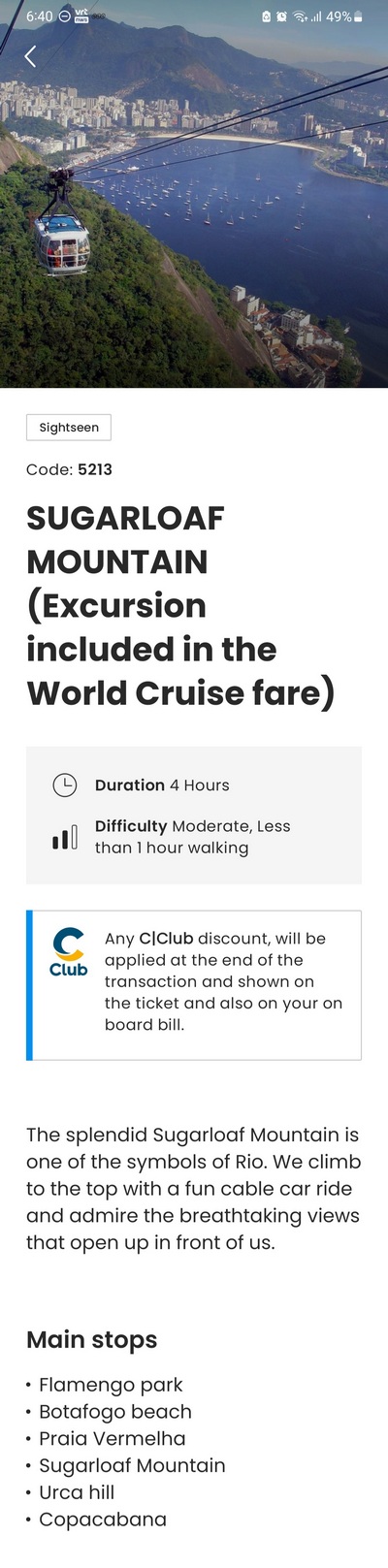
We leave the port behind us and begin exploring the city. The route gives us the opportunity of admiring Flamengo Park and Botafogo beach before reaching Praia Vermelha in the Urca neighbourhood.
A funicular cable ride takes us up to the Sugarloaf Mountain, the most famous in Rio de Janeiro and maybe among the most famous in the world for its beauty and the spectacular view that can be enjoyed from the top.
Our climb is divided into two stages . After the first, we reach Urca hill with its gardens and panoramic terraces; after the second, we can enjoy a spectacular view over the city, its beaches, Guanabara bay and the Corcovado on the horizon.
After admiring the breathtaking views, there is yet more to see. We head back to the coach and continue towards Copacabana before returning to the ship.
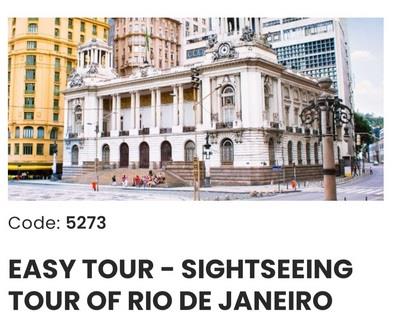
A sightseeing coach tour of Rio de Janeiro and the most iconic spots in the city, from the famous beaches at Ipanema and Copacabana to the buildings that epitomise the country's history and culture.
Main stops :
Rodrigo de Freitas lagoon
Leblón, Ipanema, Copacabana and Leme beaches
Imperial Palace
Rio de Janeiro Cathedral
Cinelândia
Municipal Theatre and National Library
The programme :
We will leave the port by coach and travel to Rodrigo de Freitas lagoon, situated in the Lagoa district in the south of the city. The lagoon is linked to the Atlantic Ocean by a canal that crosses a small park and the district that lies around it, named Lagoa because of the lagoon. It is now one of the most affluent districts in the city and is often described as "the heart of Rio de Janeiro". Due to its considerable size, the lagoon also hosts countless sports clubs and rowing, canoeing and kayaking competitions, etc. From the lagoon we can see the statue of Christ the Redeemer, which sits at the top of Mount Corcovado.
Next, we will visit the famous Leblón, Ipanema, Copacabana and Leme beaches, where we will stop to soak up the vibrant atmosphere and take some photos.
After stopping at the beaches we will head towards the city centre.
Rio de Janeiro, which means "January River", was essentially a colonial capital until 1808 when the Portuguese royal family and much of the Lisbon nobility moved here to escape the Napoleonic invasion of Portugal. The capital of the kingdom was changed to Rio, which then became the only European capital outside Europe. Given that there was no space and no urban facilities to accommodate the hundreds of noblemen, many of the inhabitants were simply evicted from their homes.
When prince Pedro declared Brazil's independence in 1822, he chose Rio de Janeiro as the capital of his new empire. It remained the capital even after the military overthrew the monarchy and imposed the Republic in 1889. In 1960, president Juscelino Kubitschek moved the capital from Rio to Brasilia.
Points of interest that we will have the chance to see on the tour include: the Paço Imperial or Imperial Palace, built in a Colonial style between 1738 and 1743 as a residence for the Portuguese governors of Brazil; Rio de Janeiro Cathedral with its unique conical shape, known as the Metropolitan Cathedral; and Cinelândia (the popular name for Floriano Peixoto Square), which takes its name from the presence of numerous cinemas, theatres and hotels. We will also find some important buildings here such as the Municipal Theatre (built in the early 20th century and inspired by the Garnier opera house in Paris), the National Library**, the biggest in South America with a heritage of over 9 million works, and various museums.